Review: Dog Day Afternoon (1975)
'You'd like to kill me? Bet you would.'
★★★★
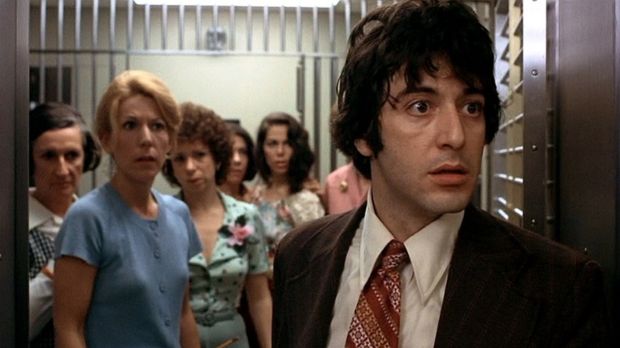
A hostage crisis arises when Sonny Wortzik (Al Pacino), an inexperienced criminal, conducts a bank robbery in Brooklyn. Things go bad very quickly. The FBI shows there, adding to the tension as Sonny and his collaborator, Sal Naturile (John Cazale), struggle mightily to maintain control over a media circus that grows. Sonny's unexpected reasons for the heist gradually come to light, as his confrontation with the police approaches its unavoidable conclusion.
"Dog Day Afternoon" is a brilliant film from beginning to end. Not only is it one of the best films of the 1970s, it also houses one of Al Pacino's unforgettable performances. His performance as Sonny easily made him a fascinating character, with you wanting more as you go on with the movie. From the moment Pacino enters the scene, to when he leaves, is truly rewarding. He's not a great robber, but he does have a heart. What he's doing is wrong, but he's trying he best to keep these hostages alive.
Sonny aspires to be everything and is several things at once. Not being able to speak with the real-life story's thief, author Pierson claims to have discovered the character's key after learning that Sonny was the type of man "who would take care of you." While brandishing the gun and entering the bank, he declares, "I'm a Catholic and I don't want to hurt anyone, understand?" He worries about the bank guard who has asthma and listens when a teller needs to go to the bathroom. He frequently declares, "I'm dyin' here," as a result of the tellers' troubles becoming his concerns.
The majority of the film is set in a bank branch and the barbershop across the street, which doubles as the "command center" for the FBI and police. Lumet's camera travels back and forth during the negotiations. Their escape route is visible from the side view down the street in either way, but it is soon blocked by a throng of people who gather swiftly and take on a life of their own. Pacino once yells "Attica," alluding to the notorious prisoner tragedy that occurred at an upstate facility, while he is threatening people on the sidewalk. Without urging, the audience yells out, "Attica!" Sal, who is pale, sweaty, shaking, and afraid, is never seen by them. When they discover that Sonny is gay, they react to him with mockery at first, then treating him like a hero.
Is Sonny gay though? Sources claim he's bisexual, others claim he's gay. Sure, the film does come out and say that he's gay, but I believe he's bisexual. Sonny loves both Angie and Leon (Liz), but he feels more committed to Liz and wants to help her transition. Leon/Liz suffers from gender dysphoria and depression and has attempted suicide several times. But going back to Sonny, being bisexual can be difficult because you love both men and women, and I can see why he struggles with his current marriage with his wife, Angie.
Many think this is a serious film. It isn't. It's not a funny film, but it blends in comedy with all the serious stuff. The scenes mix the fear of violence with insane laughter, which was a smart approach. There are three things that prevent "Dog Day Afternoon" from turning into a joke. They are Charles Durning, who plays the first-on New York City police sergeant, Cazale, and Pacino. Which is why I recommend it. Go watch it if you haven't seen it.