Review: One Flew Over The Cuckoo's Nest (1975)
'You fooled 'em all, chief.'
★★★★
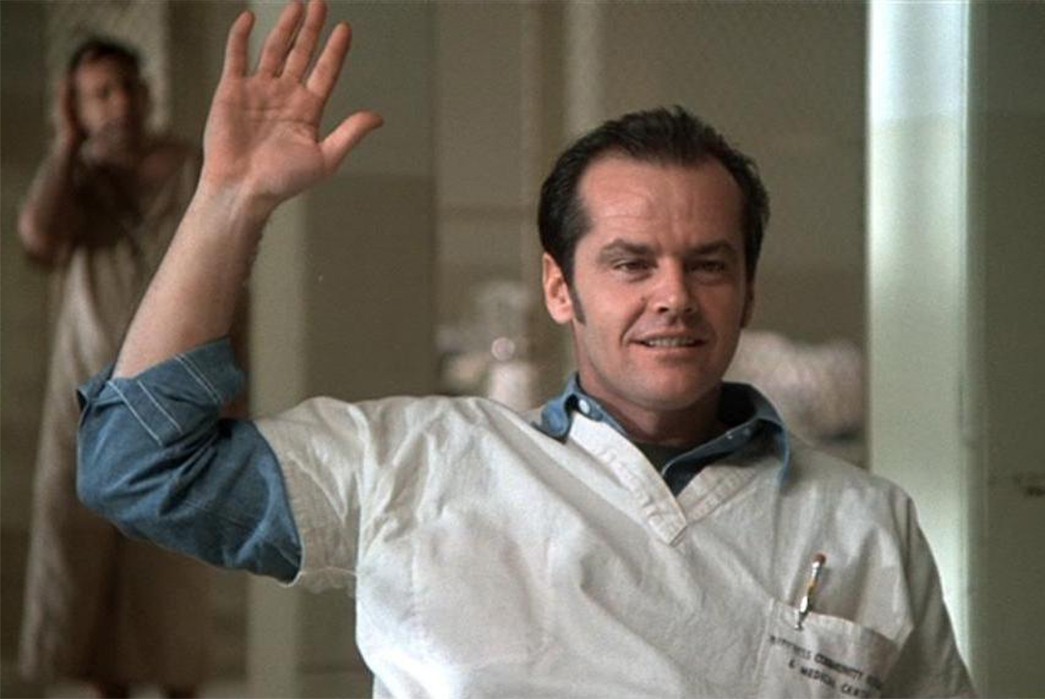
When one thinks of the greatest actors of all time, they may think of someone like Marlon Brando, Al Pacino, Robert De Niro, Leonardo Dicaprio, or even Tom Hanks. If I were to make a list like that, I would the ones I mentioned, as well as Jack Nicholson. Why would I add him, you may ask? Well, for the four or five you, I'll explain it in my review of "One Flew Over The Cuckoo's Nest."
The 1962 best-selling book by Ken Kesey, which Pauline Kael said "contained the prophetic essence of the whole Vietnam period of revolutionary politics going psychedelic," is the basis for the movie. Rewritten for the 1970s as a parable on how society enforces conformity, it almost deliberately ignored the harsh reality of mental illness in favor of making the patients seem like cutesy characters who would be easy targets for McMurphy's encouragement.
Jack Nicholson stars as R.P. McMurphy, who is lost in thought. Whatever he's thinking is the mystery of the movie. Nicholson does a perfect job of playing a character like this. He isn't mentally crazy like those in this psychiatric hospital, but he's crazy genius. All of this builds to a climactic scenario in which he is discovered dozing off on the floor by an open window. He has essentially predetermined his own fate by choosing not to flee. Has his life energy finally ran out? Has he finally reached the limit of his hope after his rebellion against the mental institution, leading the convicts in a rebellion, transforming Billy and the Chief into characters he found inspiring, and recovering from his first shock therapy dose? That's what keeps the audience engaged and wanting to know what happens next.
Nicholson's performance is one of a kind in this film. He gives it all in this film and it sells at the end. He could make us laugh, cry, sad, happy, and other emotions you could think of. Not just this with this film, but in all of his films. The underlying joke in the majority of his performances is that he gets away with things because he knows how, wants to, and has the nerve to. His characters represent freedom, anarchy, self-gratification, and rebellion against the system, as well as generous companionship and a type of careworn nobility.
McMurphy tries to befriend everyone in the facility, but fails, however, he does befriend Chief (Will Sampson), who is shown as a mute. He cannot talk, nor can he hear anything. When Chief notices how different McMurphy is, he decides to reveal to him that he can talk. Once the took become friends, they plan to escape the facility together. We also discover that Billy does not need to stutter, and others should not be crippled by shyness or fear. They will be cured not by Nurse Ratched's medications, Muzak, or discussion groups, but by McMurphy allowing them to be guys: watch the World Series on TV, go fishing, play pick-up basketball, get drunk, and get laid. The advice to these unhappy inmates is simple: Be like Jack.
This is a masterwork of theatrical naturalism; it's both straightforward and uncomplicated, yet poignant and humorous. I cannot emphasize how much of an impact this film has brought to Hollywood. This is no doubt in a lot of people's list of favorite films of all time, it's in mine as well.