Review: Planet of the Apes (1968)
You know the saying, 'Human see, human do.'
★★★★
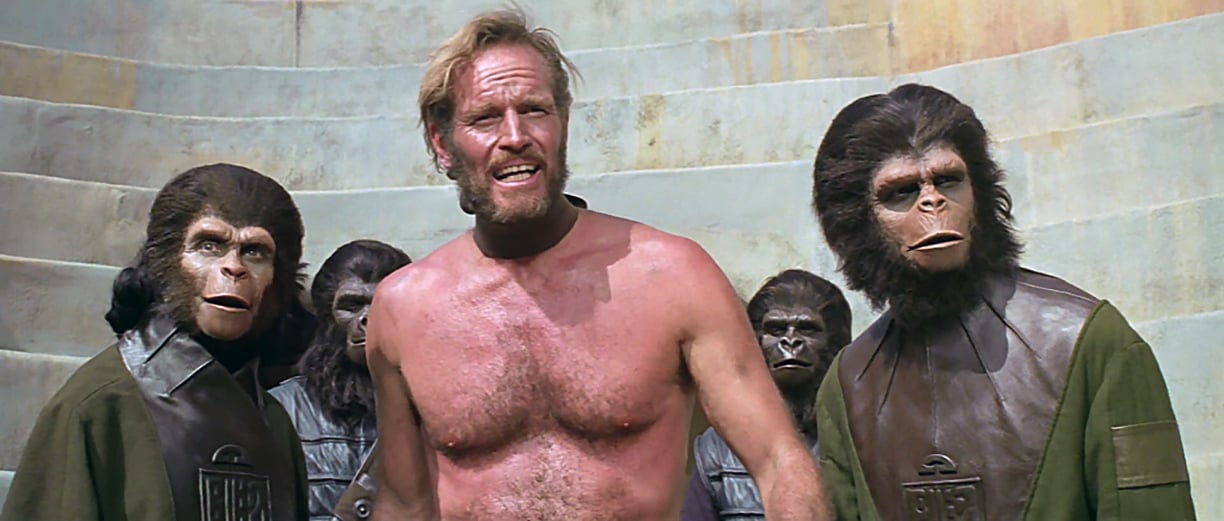
If there's one regret I have about movies, it’s that I wish I had seen them sooner. However, I’m glad I'm making up for lost time by watching a lot of great films. "Planet of the Apes" is one of those classic films that everyone, except for me, has seen. When I approached it, I had no prior knowledge other than the fact that apes seem to run everything in the story. So, I decided I should watch it and see what all the praise is about. Rather than renting it or streaming it like any normal person would, I went out and bought the DVD. The 2001 DVD, to be exact, and if any collectors are interested. Why? Simple: once I own it, it’s mine forever.
After finishing the film, I found it incredibly fascinating. The pre-credit sequence is enough to hook you in right away. The movie wastes no time in starting the adventure. I feel this way because I believe that opening scenes are crucial—arguably one of the most important parts of a movie—and it's something that directors really need to get right. Take The Godfather, for example. That opening scene is enough to introduce us to what kind of movie it's going to be. Its opening scene immediately introduces us to the Mafia world and the life of the Corleone family. From that opening alone, we understand the tone, genre, and sense of power and emotion of that world. If you haven't seen it, watch it.
Back to "Planet of the Apes," this is one of the pinnacles of science fiction. Science fiction, in my opinion, similar to fantasy, should take you to a whole new world, even if it's realistic. Sci-fi plays with real-life possibilities with scenarios that sometimes sounds absurd on paper. In other words, it should invite the audience to think.
The film opens with astronauts George Taylor (Charlton Heston), John Landon (Robert Gunner), Thomas Dodge (Jeff Burton), and Maryann Stewart all leaving Earth in search of a more civilized world. That alone should tell the audience, "Hmm, why would Taylor want to leave Earth, and why had he given up on the human race?" That I believe it was a smart, creative choice.
Another thing I liked was the minimal dialogue and the well-written script. After Taylor and his crew crash land, there are only a few lines spoken as the men, minus Stewart, explore this strange world. Franklin J. Schaffner, the director, lets the audience breathe with the silence, giving us time to absorb the scenery and the unsettling beauty of this strange planet. Once the crew learns what kind of world they're in, we're introduced to the Apes. For 1968, the makeup effects look outstanding and hold up well today. They genuinely look like apes, instead of actors in suits. At the same time, they're kind of freaky. Especially since we learn they're in place of humans, while the humans are in place of the animals. I mean, they have a whole town, government, doctors, scientists, and things us humans have. It's uncanny, but truly wonderful.
The score was done by the legend himself, Mr. Jerry Goldsmith. Whom I believe is one of two musical gods. The other is John Williams. I don't think I can describe the score in detail, other than haunting, mysterious, and majestic. Goldsmith likes to experiment with different instruments. Having listened to his other works, this was the start of his "experimental" era.
The ending of the film really gives the audience that "whoa" moment. Most people were shocked, but I really wasn't. Not because I figured it out, but because being a critical, and someone who watches a lot of George Carlin, seeing what the human race has become by the end, ultimately just proves the point of humans being different, rude, selfish, and destructive. Not only is this a film of great entertainment; this is something that allows one to think and question what truly makes us human.