Review: Portal 2 (2011)
Lemons.
★★★★
With every game released by Valve, there's always an expectation of a sequel, but it never seems to carry the number 3. The original Portal, launched in 2007, was a straightforward puzzle game that introduced the innovative mechanics of portals. This game became iconic, leading Valve to create a sequel, which I consider to be one of the best video game sequels ever made. Why do I think that? Continue reading to find out.
Let's start with the story. Portal 2 takes place—well, it’s unclear exactly when—but we do know it’s set an indeterminate amount of time after the first game, somewhere between 50 and 50,000 years later. It’s complicated, I know, but don’t think about it too much. Regardless, the player character, Chell (whom you may remember from the last game), is awoken after a long sleep by a core sphere named Wheatley (Stephen Merchant) and brought back to Aperture Science, which is now mostly in ruins. You and Wheatley soon awaken GLaDOS (Ellen McLain), an artificial intelligence designed by Aperture Science. Wheatley’s goal is to deactivate GLaDOS and take over the facility himself, using you essentially as a pawn. As you progress with Wheatley, you discover the old test chambers used between the 1950s and 1980s. Passing through them, you learn more about the lore and backstory of the Portal series. You also encounter training tapes from Cave Johnson (J.K. Simmons), the former CEO and founder of Aperture. Once you defeat Wheatley and assist GLaDOS, she surprisingly decides not to kill you and instead allows you to leave to live a normal life.
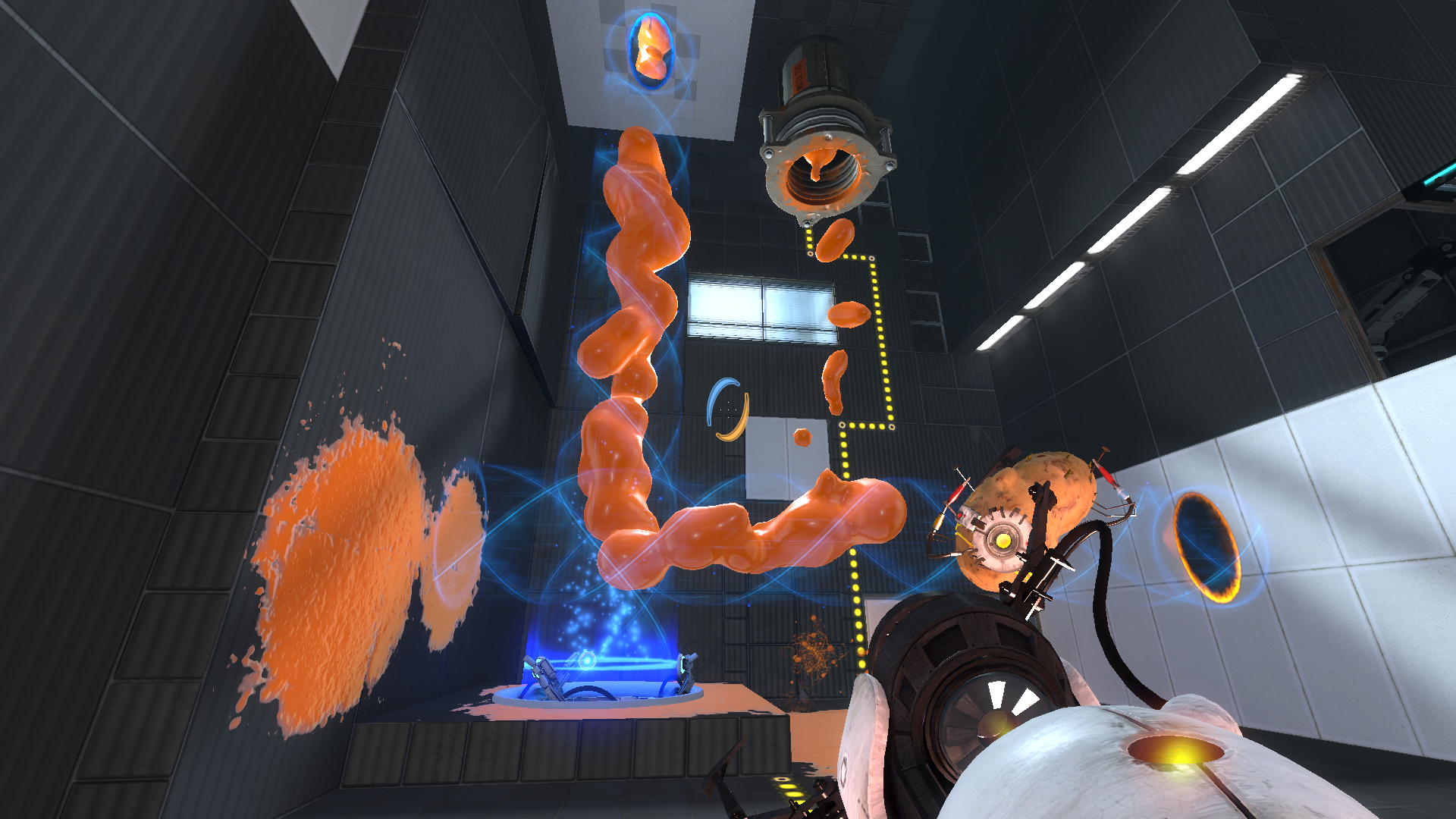
The initial concept for the game was to make it a prequel set during the “Cave Johnson” years, but Valve scrapped that idea and made it a sequel, incorporating elements from the original concept. In addition to the Portal gun, you encounter all the testing tools and equipment used in the older testing chambers. There are three different gels: blue, orange, and white. Blue lets you jump to higher places, orange lets you run fast, and white allows you to place portals on surfaces where you normally cannot. There are also "Excursion Funnels," which are like tunnels that let you transport yourself or gel to otherwise unreachable places. If you look at the picture I’ve added to this review, you’ll see an Excursion Funnel with orange gel running through it. If the funnel is blue, it moves you forward; if it’s orange, it moves you in reverse. Get used to orange and blue—they’re the signature colors of Portal.
Outside of the main campaign, Portal 2 offers even more, like custom maps and Co-Op mode. Valve has provided players with the tools to create custom maps for endless fun. When you launch any of these custom maps, a random voice clip from Cave Johnson might play, serving no purpose other than to make you laugh—just what this game aims to do.
Finally, there’s the infamous Co-Op mode. You and a friend can play through the Co-Op campaign, suffering and laughing together. Instead of Chell or a variation of her, you play as ATLAS and P-body. ATLAS is controlled by the host player, while P-body is controlled by the guest. As ATLAS and P-body, you’re given gestures to interact with each other and mess around—it’s great fun. Co-Op is a huge reason, aside from the main campaign, why players keep returning to this game. Beyond the Co-Op campaign, you can also play custom maps with a friend, keeping the experience fresh.
What more can be said about this game? Not much. I have covered everything. It's in my top ten and definitely one of the best Valve games ever made. The gameplay mechanics are incredibly polished, and the storyline draws players in with its engaging plot twists and memorable characters. Each level is meticulously designed, providing both challenge and enjoyment.