Review: Indiana Jones and the Temple of Doom (1984)
Possibly the scariest Indiana Jones film.
★★★★
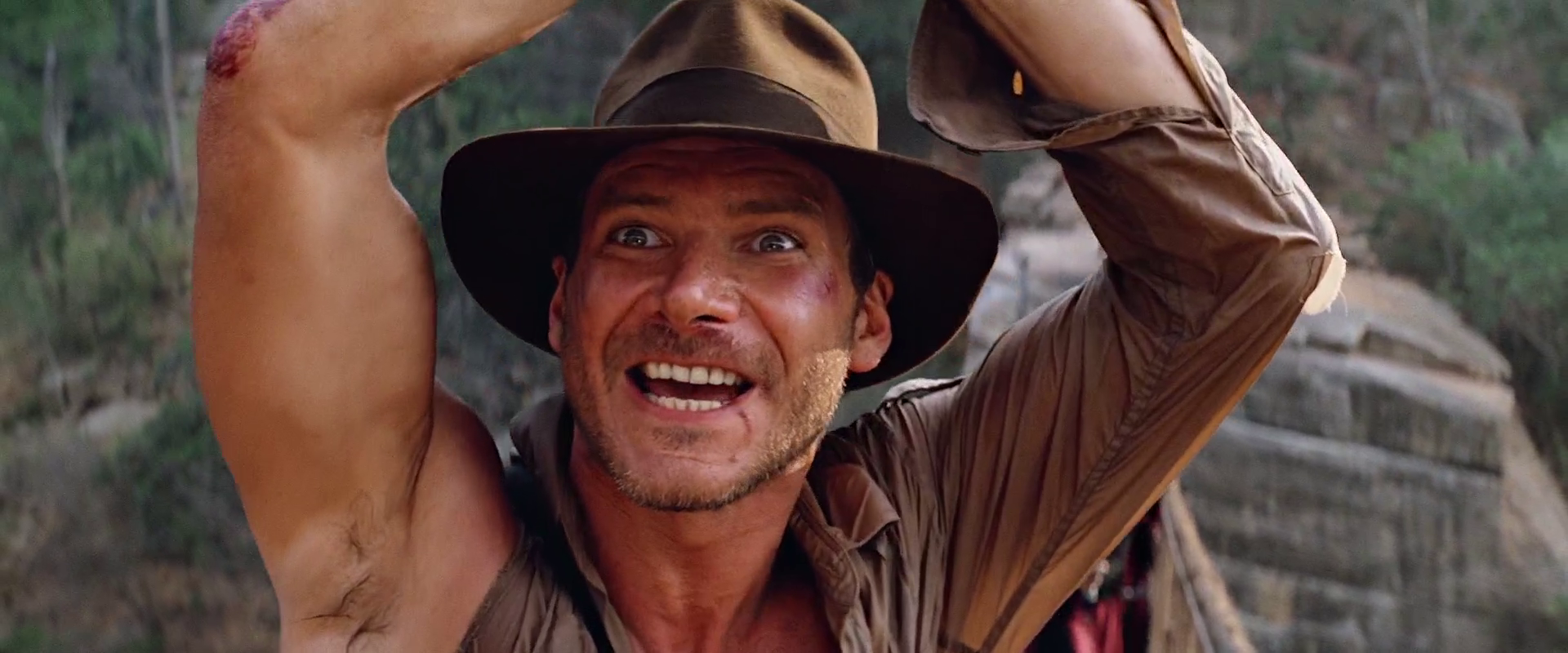
After the success of "Raiders of the Lost Ark," George Lucas and Steven Spielberg began planning a sequel, which ultimately became a prequel. Instead of fighting Nazis, George Lucas wanted to focus on something else. So, he came up with ideas involving a religious cult devoted to child slavery, black magic, and ritual human sacrifice. While that idea may have sounded fine, screenwriter Lawrence Kasdan thought it was "mean," so he turned it down. Part of the reason for George's decision to incorporate the idea of a religious cult was because he wanted to make this film dark, similar to how "The Empire Strikes Back" was. However, the film got darker than originally intended, which I'll get to later.
The plot of this film takes a year before the events of "Raiders." We find Indiana Jones (Harrison Ford) in a nightclub in Shanghai, which is called "Club Obi-Wan" (Star Wars fans will surely get that reference). Having narrowly avoided capture in Shanghai, Indiana Jones, singer Willie Scott (Kate Capshaw), and his young sidekick Short Round (Ke Huy Quan) wind up in a distant Indian town. The villagers beg Indiana to return a sacred stone that has been taken by a dark ritualistic cult that uses child labor as slave labor. While fighting both otherworldly and human enemies, Indiana discovers the cult's plans after breaking inside their underground temple. He encounters several difficult obstacles along the road, such as a thrilling mine cart chase and a dangerous rope bridge encounter, but in the end, he frees the abducted children and returns the holy stone to the villagers.
Judging from that summary alone, the plot doesn't seem as dark. But what people remember are the unsettling elements, such as bugs and insects, feelings of claustrophobia, hearts being ripped out for ritual sacrifices, and the bizarre food. There are many reasons for all of that, but the main reason was that George Lucas was going through a divorce when writing the script. Marcia Lucas, who had been married to George from 1969-1983, started to feel unhappy during her final years of marriage. She found that her ex-husband was more interested in his work than in spending any quality time with her. While working on the post-production of "Return of the Jedi," and writing the script for "Temple of Doom," Marcia asked for a divorce, but George said to wait until "Return of the Jedi" had been released. Steven Spielberg was also going through a nasty breakup, which put him in a bad mood as well. Their breakups resulted in the film being dark and edgy, but did this hurt the viewing experience for me? Not at all! It still has the feeling of Indiana Jones. But I still feel like they went a bit too far in some places.
I do have some problems with this film, though. Kate Capshaw's character, Willie Scott, screams way too much. I understand she's scared, but those screams can get painfully repetitive. The food scenes might also come across as offensive and disgusting. So, whatever you do, please don't eat while watching this movie. I also have some minor issues, but I won't address them as they're irrelevant to this review. Those are just criticisms. "Temple of Doom" is not as lighthearted as the first, but the experience is not diminished by this because it does an excellent job of presenting darkness. Harrison Ford, Ke Huy Quan, and Amrish Puri give excellent performances in this film.
"Temple of Doom" was considered the weakest of the three films, until "Kingdom of the Crystal Skull" came out, stealing its spot. Now, in 2024, it's a debate between "Crystal Skull" and "Dial of Destiny." The latest film, "Destiny" is my least favorite. I don't consider "Temple of Doom" is the worst one, or a weaker entry. It's a whole lot of fun and one of those one of the greatest "Bruised Forearm Movies" ever made. You know what a "Bruised Forearm Movie" is. That's the type of movie where your date is constantly holding your forearm in a vise-like grasp as intolerable excitement plays out on screen. You had a terrific time at the movie, but your arm was black and blue for a week after.