Marlon Brando: Actor and Activist.
Hollywood badboy, character at heart.
Written on July 1st, 2024, by Rami Abuhamra.
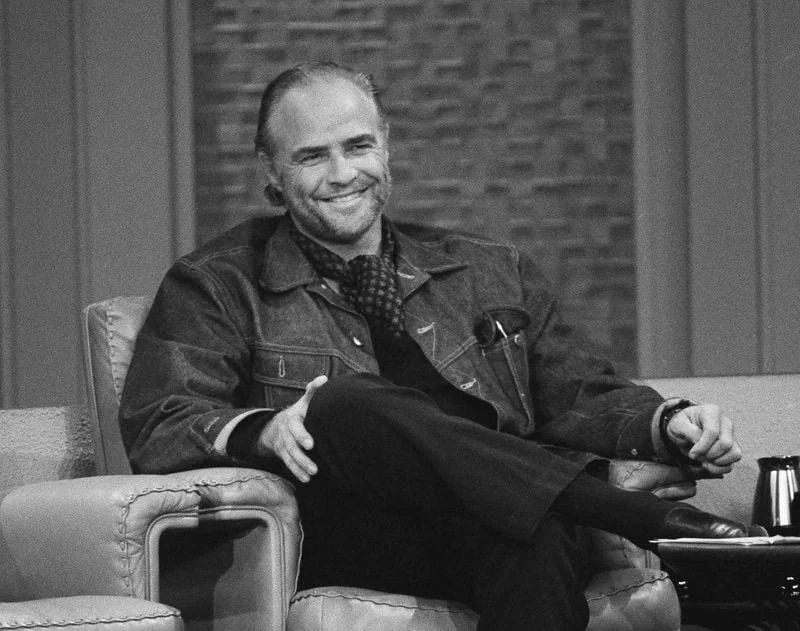
On April 3, 1924, Marlon Brando Jr. was born in Omaha, Nebraska, of Dutch-Irish descent. He was the youngest of three children of a salesman and an amateur actress. Growing up was not easy for Brando. His mother chose alcohol over raising her children, and his father was cold, abusive, and rough towards Marlon. This led to many years of neglect in Marlon's life. It got so bad that once he enrolled in high school, he was expelled for riding his motorcycle in the halls just to receive the attention he lacked at home. He failed all his classes except drama and P.E. Brando was then sent by his father to Shattuck Military Academy, where his father had also studied. There, Brando continued to develop as an actor until 1943, when he was placed on probation for being insubordinate to an officer during maneuvers. He was confined to the school but slipped into town and was apprehended. The faculty voted to expel him, despite the support from students who believed the expulsion was excessive. Brando was invited back the next year but chose to drop out of high school. He then worked as a ditch-digger in a summer job organized by his father and attempted to enlist in the Army, but a routine test revealed that a football injury he sustained at Shattuck had left him with a trick knee, rendering him physically unfit for military duty.
Brando decided to follow his sisters to New York to pursue a career in acting. At first, he started off as a stage actor, then later switched to films. His first film, "The Men" (1950), marked the beginning of his career. Critics and audience members alike praised his performance. In the following years, Brando starred in "A Streetcar Named Desire" (1951), "Viva Zapata!" (1952), "Julius Caesar" (1953), "The Wild One" (1953), "On The Waterfront" (1954), "The Godfather" (1972), "Last Tango In Paris" (1972), and others. His acting style was different, and the way he "memorized" his lines were different. He didn't memorize this lines, he instead them had cue-cards lying around set for him to read. While that may sound lazy, no other actor can do that. Robert Duvall has tried once, but it didn't work out for him. Eventually, Brando switched to a hearing aid. That way, his lines can be read to him, and he would repeat what, who is on the other end said.
Aside from acting, Marlon Brando was an activist. He was an active civil rights member and often spoke out against Hollywood's portrayal of Native Americans, Blacks, Latinos, Arabs, and Asians. “I don’t think that people generally realize what the motion picture industry has done to the American Indian, and as a matter of fact, all ethnicities, all minorities, all non-whites.” One of his greatest acts of activism was rejecting his Oscar for "Best Actor" for his portrayal of Don Vito Corleone in "The Godfather" (1972) by sending Sacheen Littlefeather. Brando also criticized the American Dream and how it only applied to Whites. "We are a country that stands for freedom, for rightness, for justice, for everyone. It simply doesn't apply to those who aren't white. It just simply doesn't apply." But if you ask me, you have to be asleep to believe the American Dream.
In Brando's later years, he struggled with personal problems regarding family, health, and reputation. The 90s were tough on Brando: his oldest son Christian was arrested for murdering his sister Cheyenne's boyfriend, his sister Frances passed away in 1994, and Cheyenne took her life the following year. Brando realized his mistakes in being the father he tried to avoid becoming and became a good grandfather. On July 1, 2004, Brando died of respiratory failure from pulmonary fibrosis with congestive heart failure at the UCLA Medical Center. The cause of death was initially withheld, with his lawyer citing privacy concerns. He also suffered from diabetes and liver cancer.
Marlon Brando was one of the greatest actors and activists of his time. He was mostly beloved by many of his co-stars, friends, and family. Brando continues to inspire many young actors, especially method actors. Brando has influenced actors like Jack Nicholson, Al Pacino, James Caan, Robert De Niro, Johnny Depp, Martin Sheen, and many others.
Among my top 5 favorite actors is Marlon Brando. It was a pleasure to witness and a true treat. I said in my review of "On the Waterfront" (1954) that Brando's performance struck a chord with me for a long time. I had never really learned anything about Marlon Brando until I watched "The Godfather" (1972), which my father had suggested to me after seeing it in a theater back in '72. Having seen "The Godfather," I was curious to see more of Brando's movies, so I picked up "A Streetcar Named Desire, On The Waterfront, Julius Caesar, Apocalypse Now," and many more. Does it really matter if I can't tell if it's Brando's acting, his performances, or his "rebellious" ways on set? Most likely not. As I saw more of Brando's movies, he gradually grew to be my favorite performer. With just a few words, his portrayal in "On the Waterfront" conveys a lot. I could spend a lifetime discussing every movie and performance that Brando has in his repertoire. Many still mourn him twenty years later.