Review: A Streetcar Named Desire (1951)
'Whoever you are, I have always depended on the kindness of strangers.'
★★★★
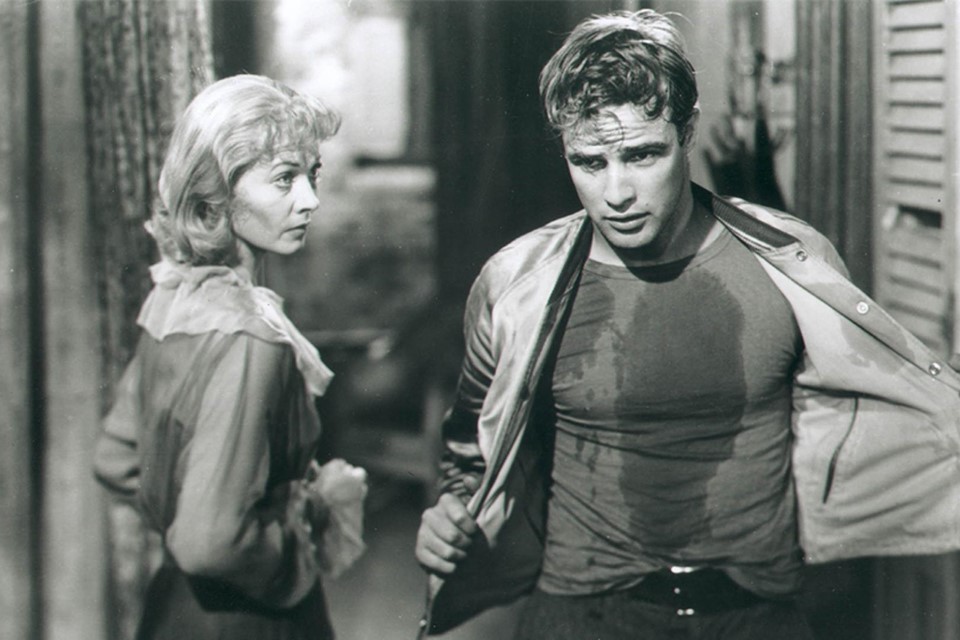
This film was the first of their three film collaboration. Based on the play by Tennessee Williams, director Elia Kazan takes this renowned drama and makes it a classic. Not only that, this film is become a testimony of great filmmaking, as Kazan proves himself that a director can have the biggest influence when adapting books and plays to films.
This well-known drama follows Blanche DuBois (Vivien Leigh), a troubled former schoolteacher, as she leaves small-town Mississippi and relocates to New Orleans to live with her sister Stella Kowalski (Kim Hunter) and her husband Stanley (Marlon Brando). Blanche's arrival disrupts the fragile balance in the Kowalski household, as her flirtatious Southern-belle demeanor and fragile mental state clash with Stanley's rough, domineering nature. As tensions rise, Stanley becomes increasingly suspicious of Blanche’s stories about her past, leading to a series of confrontations that reveal the dark truths about her life. The psychological tension escalates, ultimately driving Blanche further into madness, while Stella is caught between her sister and her husband, torn by loyalty and love.
It has come to my knowledge that the story isn't what people remember, it is the performances of Vivien Leigh and Marlon Brando. The best example I can give is their introduction scene. When Blanche first arrives at the Kowalski household, her sister Stella leaves, and she's left alone until Stanley returns from work. At first, he doesn't say anything; he just stares, looking a bit confused, until Blanche introduces herself, "You must be Stanley. I'm Blanche." That's when Brando starts talking, and the two become acquainted.
Vivien Leigh's Blanche DuBois is a sexually hungry woman posing as a sad, wilting flower; the earlier version covered up some of the hunger. Vivien Leigh's portrayal is beautiful. It is highly recognized as a brilliant and nuanced performance. Leigh strikes the delicate balance between Blanche's apparent charm and inner struggle, creating a tragic yet intriguing figure. Her portrayal of Blanche is loaded with tenderness, as she alternates between fragile grace and frantic frenzy. Leigh's ability to communicate Blanche's spiral into madness is particularly stunning, as she effectively depicts the character's progressive unraveling with haunting intensity, leaving an indelible impression on the spectator. Her portrayal is both sympathetic and unnerving, making Blanche a figure of sympathy and discomfort, capturing the complexities of Tennessee Williams' work. It's no wonder she won the Academy Award for "Best Actress in a Leading Role."
Marlon Brando is fantastic in this film as well. Brando didn't hold back, and within a few years, his approach dominated Hollywood film acting. This film directly influenced the careers of Brando's descendants, including Montgomery Clift, James Dean, Jack Nicholson, and Sean Penn. Don't believe me? Take a look at how Brando, as Kowalski, stalks through his small apartment in the French Quarter. He is, as the discourse repeatedly reminds us, an animal. He is dressed in a tattered T-shirt that displays his muscles and sweat. He smokes and drinks in a voracious manner; he lacks the nice manners that 1951 performances commonly assumed. At the same time, Brando's movements have a feline grace: he's a man, but not a clod, and in one moment, while sweet-talking his wife, Stella (Kim Hunter), he absent-mindedly takes a little bit of lint off her sweater.
It wouldn't be a proper review of "A Streetcar Named Desire" if I didn't mention the infamous, "Hey Stella!" scene. Stanley is a cold, harsh, animal in this film, but he still has a heart. He truly loves his wife, Stella. Whenever she leaves due to his recklessness, he would come crying back to her. It takes a good set of lungs to pull off that scream. The 1951 cut of that scene was much different. Stanley positions himself on the street outside his flat and yells, "Stella!" In the censored version, she stands up inside, pauses, begins down the steps, looks at him, keeps going down the stairs, and they hug. Only a few shots were altered in the unedited version, but they make a huge impact! Stella's entire manner seemed changed, as if infused with lust. In her apartment, she reacts more visibly to his voice. As she descends the stairs, close-ups show her face practically blank with longing. And the final embrace, which appears in the trimmed version to be consoling him, appears in the uncensored version to be abandoning herself to him.
Brando may not have won the Oscar for "Best Actor in a Leading Role," but it probably wouldn't mean much, as he probably would've used it as a doorstop like he did with his Oscar for On The Waterfront. But regardless, he didn't need Oscars to show that he was one of the greatest actors of all time. His performances speak for themselves.